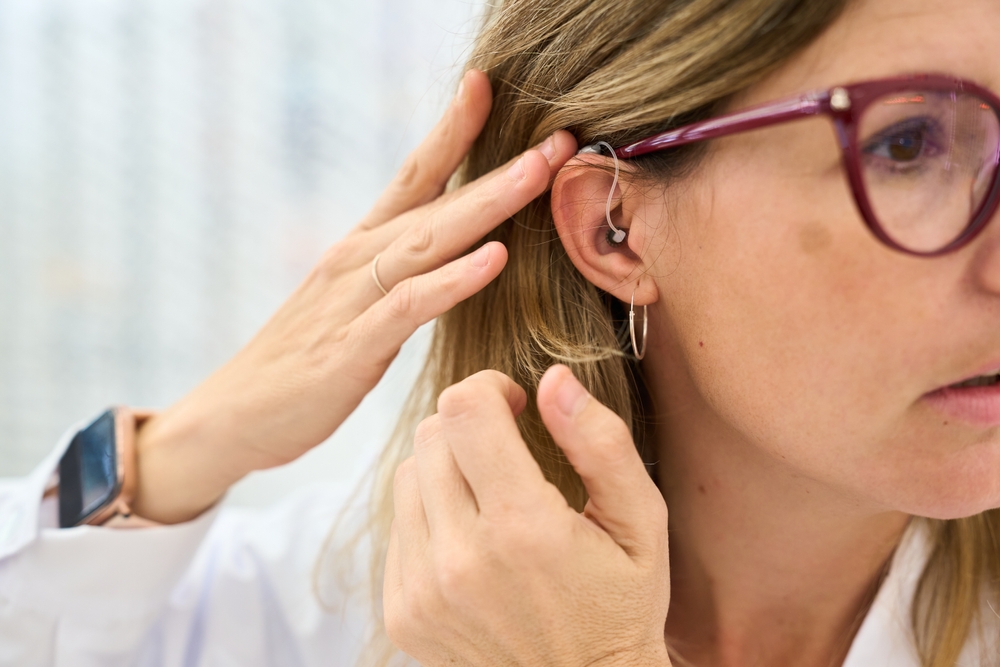
A primary reason individuals put off addressing auditory deficits is the assumption that assistive devices will be unsightly or awkward to wear. For years, hearing aids were large, noticeable, and often negatively associated with getting old. In some cases, people even worried that they might be left out of conversation altogether by others who assumed they wouldn’t be able to hear or comprehend.
Consequently, this outdated, negative stereotype persists, preventing numerous individuals from seeking professional care. But the reality is that today’s modern hearing aids look and feel very different from what you might expect. Ongoing innovations in cosmetic engineering mean today’s options are ultra-small, seamlessly comfortable, and beautifully hidden from public view.
If you have spent years avoiding an audiologist due to the appearance of old devices, now is the perfect moment to explore today’s sleek alternatives!
The Hearing Aid You’re Picturing Doesn’t Really Exist Anymore
When asked to visualize a hearing instrument, the average person still envisions an awkward, highly conspicuous piece of hardware visible from yards away. Should that be your current expectation, you are inadvertently recalling the clunky designs common to the 1980s and 1990s.
Over the last few generations, this medical technology category has experienced a total structural evolution. Continuous refinements in ergonomic styling, nanometer-scale circuitry, and digital audio engineering have radically overhauled the modern cosmetic profile. Current product lines are incredibly compact, architecturally clean, and purpose-built to harmonize with your features or sit entirely out of sight.
Many of today’s devices sit fully inside the ear canal, making them virtually invisible during everyday conversation. Alternatively, post-auricular models are constructed with such streamlined dimensions that they disappear against the scalp, customizable to complement individual skin and hair coloration.
A Taxonomy of Modern Styles: From Totally Hidden to Ultra-Streamlined
To understand how these sophisticated medical devices are physically configured, review this concise anatomical breakdown:
Deep Canal Solutions: Invisible-in-Canal (IIC)
For total subtlety, these instruments have no medical equal. IIC devices sit completely inside the ear canal and are custom-made to fit your ear. When engaging with others at standard social distances, these units are utterly unnoticeable to the naked eye. They represent an ideal intervention path for mild-to-moderate hearing impairments when user stealth is the top priority.
Modern Standards: Receiver-in-Canal (RIC) / Receiver-in-the-Ear (RITE)
This particular layout has become the benchmark standard for contemporary hearing health restoration. A tiny component sits behind the ear, connected by a nearly invisible wire to a small speaker in the ear canal. To a casual observer, their clean lines often mimic high-end commercial wireless earbuds. Surrounding individuals will remain completely unaware of the technology unless they actively look for it.
Behind-the-ear (BTE)
These sit fully behind the ear and are slightly larger, but they’re still far more streamlined than older versions. Frequently utilized to remediate severe-to-profound auditory loss, they maximize gain and processing capability while maintaining a highly professional, low-profile aesthetic.
Ultimately, contemporary hearing aids are built to empower your daily routine rather than broadcast a medical condition to the world.
The Functional Revolution: Modern Instruments Are Tiny Supercomputers
The changes in modern hearing aids aren’t just cosmetic. Today, they function more like smart devices than traditional medical equipment. Most current systems boast universal wireless syncing, channeling smartphone calls, high-definition music, and television broadcasts directly to your internal receivers.
Equipped with dedicated smartphone applications, they allow users to manipulate volume matrices or toggle environmental programs without making manual physical adjustments. Say you’re walking into a noisy restaurant: You can fine-tune your hearing to match the environment in seconds. Furthermore, lithium-ion rechargeable cells have entirely eliminated the need to fiddle with microscopic, short-lived zinc-air batteries. The process is as simple as placing the units into their charging dock each night, identical to charging your cell phone.
Overcoming the Psychological Barriers to Better Hearing
Despite understanding these technological quantum leaps, psychological resistance remains highly common. Initiating an auditory health journey can feel emotionally taxing because it requires acknowledging that our physical baseline has shifted over time. This can make us feel helpless and like we aren’t fully in control of what’s happening to our bodies.
Consider a healthier perspective: wearing a contemporary hearing system does not mean your body has failed you. They are simply tools for managing standard lifecycle changes, which are a normal part of the human experience. Adopting this tech is definitive proof that you are actively taking charge of your health to empower and protect your daily cognitive function.
Imagine wearing a discreet, barely (if at all) visible device and finally being able to follow along in conversation, hear better in crowds, and focus on the things that really interest you. This is the definition of true personal empowerment!
See For Yourself What Today’s Hearing Aids Look Like
The most effective method to permanently banish an obsolete stereotype is to personally examine current clinical options. We invite you to come in, ask questions, and explore your options with no pressure and no commitment necessary. Treat this as a risk-free exploratory step to comprehend the incredible aesthetic shift that has occurred in our field.
Almost every visitor walks out completely shocked by how weightless, ergonomic, and cosmetically invisible these tools are in practice! Reach out to our administrative team or visit our website right now to book your personal demonstration.